

About the RISE Mini Grant Program and Awardees
In Spring 2026, The Indigenous Resilience Center (IRes) launched"Regenerative Indigenous Solutions for the Earth (RISE)” Project, a comprehensive initiative focused on advancing tribally driven, regenerative agriculture and land stewardship. By centering Indigenous knowledges guided by IRes’ core values, the RISE Project seeks to strengthen sustainable food systems, improve human and environmental health, and expand economic development opportunities within Tribal communities.
With support from the Waverley Street Foundation, the National Science Foundation, and the Agnese Nelms Haury Program, IRes is excited to announce the recipients of the 2026 RISE Mini-Grants that have been selected as part of efforts to support community-led efforts and seed funding to support food-energy-water resilience projects that address a combination of the following focus areas:
● Food: regenerative agriculture and foodway systems
● Energy: renewable energy
● Water: water conservation and monitoring
Building on the success of previous Community Environmental Impact Awards, this program seeks to support grassroots and frontline organizations working to strengthen Indigenous community resilience.

Alexander Pancho Memorial Farm
Project Title: Feeding the Community from the Desert: Traditional O'odham Agriculture at the Pancho Memorial Farm
Project Lead: Noland Johnson, Farm Manager
About:
The Alexander Pancho Memorial Farm is a 40-acre traditional dryland family farm located in the Kawulk community of the Tohono O'odham Nation. It grows traditional O'odham crops, relying strictly on monsoon rainwater, and serves as a training farm for beginning and established farmers, teaching regenerative desert agriculture in cooperation with Ajo Center for Sustainable Agriculture. Tohono O'odham communities have some of the highest rates of type 2 diabetes in the world; returning traditional foods to tables and institutions directly supports community health. Pancho Farm, in collaboration with its community partners, helps to restore O’odham foodways and agricultural knowledge across generations. Building the farm’s own supply capacity advances food sovereignty and community economic self-determination.
Project Summary:
The Alexander Pancho Memorial Farm will implement a two‑year project to expand the reach of traditional Tohono O’odham foods and strengthen community food sovereignty through dryland agriculture, wild food harvesting, and intergenerational education. Using Ak‑Chin monsoon‑based farming methods supported by solar‑powered irrigation, the farm cultivates tepary beans, O’odham corn, squash, and other desert‑adapted foods while leading seasonal harvests of wild foods such as saguaro fruit, cholla buds, mesquite pods, and prickly pear. With core infrastructure now in place, the project will focus on building a “ground‑to‑institution” supply chain: in Year 1, the farm will begin supplying traditional foods to the Kaji Ki Native foods pantry and delivering foodways education from that space; in Year 2, the farm will establish a pilot agreement to supply traditional foods to a reservation institution. Supported by partners including the Ajo Center for Sustainable Agriculture and the San Xavier Co‑op Farm, and strengthened by RISE funding, the project will develop food‑safe processing and storage capacity, advance permit‑ready plans for a future indoor facility and expand hands‑on foodways programming. By June 2028, the farm will be equipped to harvest, process, store, and deliver traditional foods at a reliable scale, operate a vibrant education program, and be positioned for continued growth, advancing O’odham health, resilience, and cultural continuity through traditional foods.

Flower Hill Institute
Project Title: The Pueblo-Hopi Cultural and Agricultural Exchange Project
Lead: Bryn Fragua- Agriculture, Technical and Tribal Coordinator
About:
Flower Hill Institute is an Indigenous-led nonprofit dedicated to supporting the resilience of Tribal Nations. Since 2015, Flower Hill has worked with Tribal Leaders and their communities to provide complex problem-solving support and technical assistance on the most pressing issues facing Indigenous communities across the United States. The Flower Hill Institute envisions a future where Indigenous communities thrive—freely practicing our cultures, growing our economies, and providing for our people. By bridging tradition and innovation, we create cultural, economic, and environmental resilience in our communities.
Project Summary:
The Pueblo-Hopi Cultural and Agricultural Exchange Project seeks to strengthen relationships between the Hopi Tribe and the Pueblo Farmer Alliance through a series of reciprocal cultural and agricultural exchanges conducted over the project period. This initiative builds upon relationship-building efforts that were initially facilitated through collaborative work with the University of Arizona and further advanced through the Pueblo Agriculture Needs Assessment led by Flower Hill Institute. The assessment identified common agricultural priorities and opportunities for collaboration among Pueblo communities, ultimately contributing to the establishment of the Pueblo Farmer Alliance.
In 2025, the All-Pueblo Council of Governors (APCG) formally passed a resolution creating the Pueblo Farmer Alliance, a coalition dedicated to strengthening Indigenous agriculture through collaboration among Tribal government agricultural departments, producers, nonprofit organizations, educators, and other agricultural stakeholders. The Alliance serves as a platform for knowledge sharing, capacity building, and the advancement of food sovereignty initiatives across Pueblo communities.
Through this project, Hopi and Pueblo agricultural leaders, producers, youth, and community members will engage in reciprocal exchanges that foster cultural understanding, strengthen agricultural practices, preserve traditional knowledge, and support the development of sustainable Indigenous food systems. By creating opportunities for relationship-building and shared learning, the project will enhance regional collaboration and contribute to the long-term resilience of Tribal agriculture throughout the Southwest.

Flowers & Bullets
Project Title: Flowers & Bullets Midtown Farm: Cultivating Indigenous Resilience Through Food Sovereignty, Land Stewardship, and Community Leadership
Project Leads: Jesus "Tito" Romero, Farm Director and Co-Founder; Jacob Robles, Farm Manager; Martin Valdez, Field Manager
About:
Flowers & Bullets (F&B) is a grassroots non-profit organization advancing environmental justice in Tucson, Arizona. F&B was formed in 2012 by three Indigenous members who grew up in Barrio Centro, a neighborhood that has been disproportionately impacted by industrial and military pollution, disinvestment, and over-policing. Their work serves low- to moderate-income Latinx and Indigenous relatives in this area. F&B cultivates opportunities where our community can reclaim ancestral empowerment through the preservation of Indigenous traditions that can transmute legacies of environmental racism and food apartheid. For years, Flowers & Bullets has led environmental, food, and climate justice work through developing and incorporating Indigenous Knowledge systems and sustainable technologies. This includes installing rainwater systems and gardens, reforesting their neighborhood, hosting green workforce development programs, leading reentry programs for formerly incarcerated kin, and hosting workshops on gardening, tree-planting, water harvesting, financial literacy, entrepreneurship, and more.
Project Summary:
Flowers & Bullets will implement a two‑year project to expand agricultural production at Midtown Farm from 0.25 acres to 2 acres while advancing Indigenous food sovereignty, community resilience, and youth leadership. The expanded acreage will support a regenerative, closed‑loop system that integrates forage production, soil health improvements, composting, livestock grazing, and the cultivation of Indigenous and arid-adapted crops. The project will involve extensive community engagement through volunteer days, workshops, and knowledge‑sharing events, while providing hands‑on workforce development opportunities for youth interns. Throughout both years, activities will include land preparation, infrastructure installation, soil amendment, forage cultivation, food production, and data collection to measure progress in food access, soil regeneration, youth participation, and community involvement. The project will distribute food through the Tiendita and local food access programs, ensuring culturally relevant and affordable options for low‑income households. The effort also incorporates regional collaboration and peer exchanges with Native-led organizations to strengthen Indigenous food systems, climate adaptation strategies, and Community-Based agricultural knowledge.

Fort Yuma Quechan Tribe
Project Title: Quechan Community Garden & Walking Museum
Project Leads: Michael Jack, Parks and Recreation Director; Quentin Barley, Parks and Recreation
About:
The Fort Yuma Quechan reservation is located along both sides of the Colorado River near Yuma, Arizona. The reservation borders Arizona, California, and Baja California, Mexico. Encompassing 45,000 acres, the reservation is bisected on the south by Interstate 8 (I-8). As a result, several million cars a year drive through the Fort Yuma Quechan Reservation on their way to and from Phoenix and San Diego. Largely an agricultural community, the Tribe leases its thousands of acres for agriculture to both Indian and non-Indian farmers. The Quechan Parks & Recreation Department brings technical experience hosting traditional learning opportunities for the community at large and specializes in gatherings and educational practices for its community of approximately 4,000 members.
Project Summary:
The Quechan Community Garden and Walking Museum will be developed within Anya Nitz Pak/Sunrise Point Park to create an intergenerational teaching space that strengthens cultural resilience, promotes food sovereignty, and preserves traditional Quechan knowledge. Under the Parks & Recreation Department's leadership, the project will include designing and constructing a greenhouse, garden beds, and irrigation systems; developing culturally accurate interpretive signage in collaboration with elders and language bearers; and preparing the site with support from maintenance staff and the Quechan Youth Group. Through hands‑on participation from families, youth, and elders, the project will showcase traditional homestead practices, highlight the historical significance of the Colorado River, and cultivate a community learning environment that revitalizes farming, fishing, and harvest-gathering traditions for future generations.

Hopi Tutskwa Permaculture Institute
Project Title: Hopi Tutskwa Watershed Camp; Spring Restoration Project
Project Leads: Hawthorne Dukepoo, Farm Manager; Lilian Hill, Director
About:
Hopi Tutskwa Permaculture Institute (HTPI) is an Indigenous-led nonprofit based in Kykotsmovi Village on the Hopi Reservation. HTPI provides holistic community education grounded in Hopi culture, permaculture, and empowerment. Their work addresses key issues affecting the Hopi community, including growing culturally significant food, stewarding traditional seeds, restoring watersheds and foodsheds, developing sustainable housing and renewable energy, creating business opportunities, and supporting regional land stewardship. HTPI delivers high-quality, hands-on training to local farmers, youth, and community members, which supports our organization’s ongoing growth. Their efforts have expanded their farmer network, increased awareness of seed stewardship, and promoted Hopi traditional agricultural practices. HTPI engages youth and elders in projects that encourage the continuation of their language and culture through meaningful, practical activities. Additionally, HTPI helps to develop leadership skills to strengthen local food systems, promote traditional ecological knowledge, and build local food markets and co-ops. HTPI programs nurture emerging inter-tribal leaders and support sustainable housing, earth-based solutions, and youth leadership. HTPI board, staff, alumni, community leaders, and partners are dedicated to long-term planning to ensure a thriving community.
Project Summary:
This project will strengthen Indigenous land stewardship by restoring watersheds and springs in the Oraibi Valley while training Hopi youth to become skilled land stewards grounded in Hopi identity and cultural knowledge. Through earthwork interventions, including one‑rock dams, check dams, gabions, Zuni bowls, beaver dam analogs, and swales, the project will address severe erosion, slow and disperse rainwater, and support natural groundwater recharge. Restoration efforts will target approximately ten springs through cleaning, relining cisterns, installing wildlife drinkers, removing invasive species, reseeding riparian vegetation, and protecting fragile areas from livestock. Additional activities will support orchard recovery, wetland restoration, and installing cisterns and piping to improve water storage and distribution. The project integrates intergenerational learning, community-driven research, and Indigenous knowledge systems to strengthen climate resilience, improve ecological health, and sustain culturally significant agricultural and land management practices for future generations.
The Hopi Tutskwa Permaculture Institute project is supported by funding from the Agnese Nelms Haury Program.
Nalwoodi Denzhone Community
Title: Revitalizing Regenerative Apache Food Production for Tribal Food Hubs
Project Leads: Eric Shin, Executive Director; Madchien Albert, Community Outreach Coordinator
About:
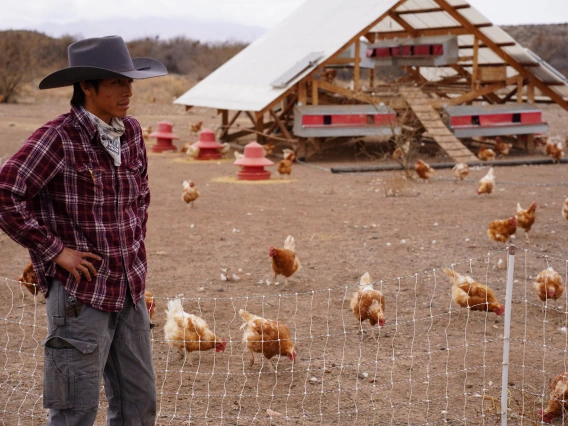
Nalwoodi Denzhone Community was established in 2012 with programs that focus on food security and community revitalization for the San Carlos Apache community. Today, through tribal and non-tribal partnerships, NDC’s focus is to bring greater holistic health to the San Carlos Apache people. The San Carlos Apache Reservation faces persistent food insecurity, high rates of diabetes, and the ongoing loss of traditional food knowledge. Many families live in a USDA-designated food desert, relying on expensive, low-quality store-bought foods that contribute to poor health outcomes. In response, Nalwoodi Denzhone Community (NDC) is currently establishing Tribal Food Hubs and developing the “Apache Food is Medicine” Produce Prescription Program in partnership with the San Carlos Apache Healthcare Corporation (SCAHC) and the San Carlos Apache Tribe (SCAT). However, consistent, local production of traditional and nutritious foods is a critical gap in the food system.
Project Summary:
The Revitalizing Regenerative Apache Food Production for Tribal Food Hubs project will expand regenerative gardening and traditional Apache agriculture at the NDC farm site to strengthen tribal food sovereignty, improve community health, and rebuild intergenerational connections to Apache foodways. Over two years, NDC will grow heirloom and culturally significant crops, such as Apache Giant Squash, using regenerative practices that enhance soil health, conserve water, and preserve seeds, with all produce supplied directly to developing Tribal Food Hubs and the “Apache Food is Medicine” Produce Prescription Program. A central component of the project is hands-on youth education, engaging 30–50 high school students annually in garden planning, planting, maintenance, harvesting, and seed saving, while staff participate in targeted training to integrate best practices from other Indigenous agriculture sites. By expanding the gardens to a two‑acre teaching and production space, increasing local food access, strengthening partnerships with schools and healthcare providers, and reconnecting youth and community members with Apache agricultural knowledge, the project will reduce food insecurity, support improved health outcomes, and strengthen long-term community resilience and cultural revitalization.

Nihikeya
Project Title: Diné Agroecology Project: K’e Based Community Engagement Towards Watershed and Food System Restoration
Project Lead: Roberto Nutlouis, Executive Director
About:
Nihikeya means “Our Home/Our Foot Print" and its mission is to restore regenerative Diné ecological, cultural, social, and economic systems and lifeways, guided by Diné traditional knowledge, teachings and practices. Nihikeya partners with local and national organizations to advance its mission to organize communities around Food Sovereignty, Climate Justice, Just Transition, and Ecological Justice. Nihikeya organizes through community engagements to restore their watershed’s life functions and resilience by healing erosion, harvesting rainwater, spreading runoff, restoring plants and wildlife habitats, and managing community farms with traditional and innovative regenerative methods: Dine Agro-ecology.
Project Summary:
Nihikeya will lead a two‑year pilot project in Range Unit 402 in Burnt Corn Valley on the Navajo Nation to develop a culturally grounded, community‑driven stewardship framework for watershed and food systems restoration that strengthens climate resilience. Building on earlier workshops in the Blue Gap Chapter, the project will convene permit holders, clan mothers, elders, and youth to assess current land conditions, document traditional Diné stewardship knowledge, and identify priorities using Diné Fundamental Law, the Four Pillars of Diné Knowledge, and the Hooghan Dialogue process. Year 1 will center on community gatherings focused on understanding watershed health, food systems, and ecological conditions, while Year 2 will shift to clan‑based planning to develop integrated restoration strategies, including identifying priority sites, exploring regenerative development, and finalizing stewardship plans for RU 402. Supported by hydrologists, engineers, and natural resource experts through the RISE network, Nihikeya will synthesize community input, ecological data, and traditional knowledge to produce a Diné‑led, replicable stewardship planning framework that strengthens watershed health, food sovereignty, ecological restoration, and long‑term climate resilience across the Navajo Nation.

Salt River Pima-Maricopa Indian Community
Project Title: Growing Resilience: Indigenous Foodways, Seed Stewardship, Water Resilience, and Outdoor Teaching Kitchen at the SRPMIC Community Garden
Project Leads: Jeffrey Wilson, Ph.D., Community Garden Supervisor, Cultural Resources Department, Salt River Pima-Maricopa Indian Community
About:
For thousands of years, agriculture has been central to the culture and heritage of the Salt River Pima-Maricopa Indian Community. The ancestors of the Akimel O’odham and Piipaash used the waters of the Salt and Verde Rivers to cultivate foods well adapted to the desert environment and support self-sufficient communities. Over time, historical and outside forces greatly reduced the Community’s ability to grow and rely on its own traditional foods, contributing to impacts on health, cultural continuity, and overall well-being.
The SRPMIC Community Garden, housed within the Cultural Resources Department, works to support physical and cultural health by reconnecting Community members with agricultural heritage, traditional crops, foodways, seed stewardship, and hands-on learning. The Garden’s long-term goal is to help strengthen food sovereignty, cultural education, and community resilience.
Project Summary:
The Salt River Pima-Maricopa Indian Community will strengthen Indigenous food-water resilience through a two-year Community Garden project that expands traditional crop demonstration areas, supports regenerative agriculture and water-conscious cultivation, strengthens the Garden’s existing traditional/heirloom seed bank through seed stewardship education and supplies, and creates an outdoor teaching kitchen for hands-on foodways education.
Building on recent revitalization and growing community engagement at the SRPMIC Community Garden, the project will develop culturally meaningful, climate-resilient crop plots; promote soil health and water conservation practices; strengthen existing seed stewardship and seed bank capacity; and provide instructional space for preparing and preserving foods grown on site. Through integrated education on traditional foods, seeds, water, land, and cultural practices, the project will create a long-term, community-centered model for Indigenous agriculture, food sovereignty, and resilience that continues to benefit SRPMIC beyond the grant period.

Tohono O'odham Community College
Project Title: Jewed Ñeok O'odham: Voices of the O'odham Earth — A Soil Analysis Micro-Certificate for Tribal Farmers
Project Leads: Adrian Quijada, Director, Land Grant Office of Sustainability (LGOS); DeAnndra Porter — Nutrition and Food System Coordinator, Land Grant Office of Sustainability (LGOS)
About:
The Tohono O'odham Community College (TOCC) is a 1994 Land Grant Institution serving the Tohono O'odham Nation across a 2.8-million-acre reservation in southern Arizona. Through its Land Grant Office of Sustainability (LGOS), TOCC delivers Community-Based research, agriculture extension programming, and micro-certificate education grounded in the O'odham Himdag — the holistic worldview of living in harmony with land, water, and all living relations. TOCC's existing micro-certificate programs in agribusiness, farrier business, and natural resources management provide an institutional foundation for this new soil analysis certificate.
Project Summary:
The Jewed Ñeok O'odham (Voices of the O'odham Earth) project will establish a fully TOCC-designed and credentialed soil analysis micro-certificate program that equips Indigenous farmers and students across southern Arizona with hands-on skills to assess and monitor soil health using culturally grounded, accessible, and locally controlled methods. Over two years, TOCC will develop and deliver a four‑week intensive training that integrates Indigenous traditional ecological knowledge with core soil science techniques, provides participants with individual soil analysis kits, and uses partner agricultural lands for field-based instruction. TOCC will manage all curriculum development, instruction, assessment, data management, and reporting, ensuring the program strengthens Indigenous data sovereignty through use of the O'odham Ñi’okĭ Ki: database. By expanding technical capacity, reducing reliance on commercial laboratory testing, and supporting long-term food system resilience across Tohono O'odham, Pascua Yaqui, Apache, and allied communities, the project creates sustainable, community-held infrastructure for regenerative agriculture and Indigenous self-determination.